
A home server that crashes once every few weeks can be much harder to troubleshoot than one that fails every hour. When the problem is repeatable, you can usually reproduce it, watch the system while it happens, and test potential fixes. Random crashes are different. The server may run perfectly for days and then suddenly freeze, reboot, shut down, or become unreachable without an obvious explanation.
The temptation is to blame the newest software update, a Docker container, an aging hard drive, or simply “bad hardware.” Sometimes that guess is correct, but guessing makes these problems unnecessarily difficult. A random crash can come from overheating, unstable memory, storage errors, power problems, kernel issues, a failing component, or an application that is exhausting system resources.
The most useful approach is to treat every crash as an investigation. Record what happened, preserve the available evidence, and gradually eliminate possible causes. You may not find the answer after the first crash, but a few carefully collected clues can eventually reveal a pattern.
First, Define What “Crash” Actually Means
Before looking at logs, determine what the server is doing when you say it has crashed. A complete power-off is different from an automatic reboot, and both are different from a system that remains powered on but stops responding.
For example, if the fans and indicator lights remain on but you cannot connect through SSH, the machine may be frozen rather than powered off. If it immediately restarts, the operating system may have encountered a serious fault or the system may have lost power. If the machine shuts down cleanly and records a normal shutdown event, software or a scheduled task becomes more interesting.
These distinctions matter because different failures leave different evidence.
A useful first step is to write down exactly what you observe: whether the screen goes blank, whether the server reboots, whether network access disappears, whether storage devices remain active, and whether the system starts normally afterward. Even a simple description can narrow the investigation.
Look At The Logs Before Changing Anything
Logs are often the closest thing you have to a witness.
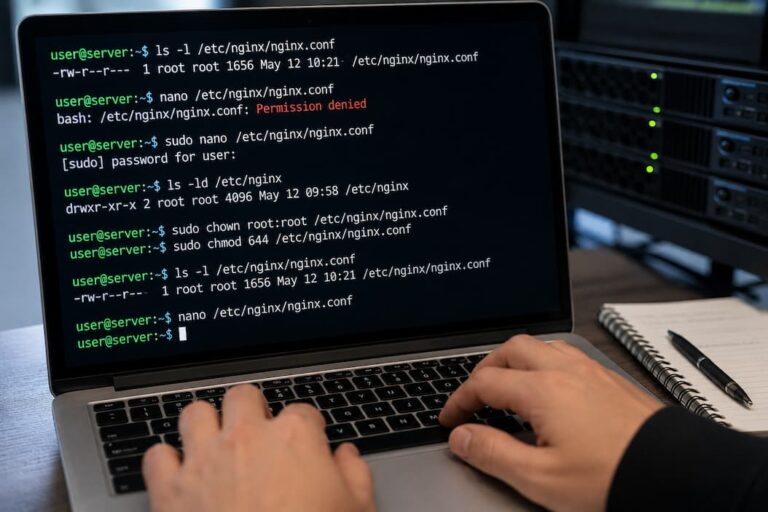
Linux systems record information about the kernel, services, authentication events, hardware, storage, networking, and other parts of the operating system. The exact commands and locations vary by distribution, but tools such as journalctl, dmesg, and system logs can provide valuable clues.
The important point is timing. Don’t only look at the last few lines after the server comes back online. Look at the period immediately before the failure and search for warnings or errors that appeared repeatedly.
You might find evidence of a filesystem problem, an out-of-memory event, a driver failure, a kernel error, or a service repeatedly restarting. You might also find nothing useful at all. That doesn’t mean the logs are useless; a sudden power interruption, hard lockup, or motherboard-level failure may prevent the operating system from recording a useful final message.
A crash with no final software error is itself a clue.
Check Whether The Server Actually Rebooted
After a suspected crash, determine whether the system rebooted or simply became unreachable.
On Linux, commands such as uptime and last can help establish when the system started and whether there were recent reboot events. If the server’s uptime is only a few minutes when you expected it to have been running for weeks, something caused a restart.
This distinction becomes especially useful when the machine appears to recover by itself. A spontaneous reboot may point toward a kernel problem, hardware instability, power interruption, watchdog behavior, or another serious failure.
If the server remains powered on but stops responding, the investigation changes. You may need to consider memory instability, kernel deadlocks, driver problems, storage stalls, or a service consuming resources until the system becomes effectively unusable.
Temperature Problems Can Cause Intermittent Crashes
Heat is one of the first hardware-related causes worth checking, particularly on a server that works normally during light workloads but becomes unstable under sustained activity.
Processors, storage devices, motherboard components, and power circuitry all operate within temperature ranges. A dusty heatsink, failing fan, restricted airflow, or poorly positioned server can gradually increase temperatures until a component becomes unstable or throttles.
The difficulty is that temperature-related crashes aren’t always obvious. The server may work normally for days because its workload is light. A large file operation, media transcoding job, backup, or virtual machine workload can then increase heat enough to expose the problem.
Monitor temperatures over time rather than checking them only after a crash. If the system is consistently approaching unusually high temperatures before failures, investigate cooling and airflow.
Also consider the physical environment. A home server installed inside a cabinet with little ventilation can behave very differently from the same hardware sitting in an open, well-ventilated area.
Memory Problems Can Be Surprisingly Difficult To Diagnose
Unstable or defective RAM can produce some of the most confusing home-server crashes.
A memory problem may not cause an immediate failure. Instead, the system might run for several days before a particular workload happens to use the affected memory area. This can make the crash appear completely random.
If you suspect memory, run an appropriate memory diagnostic rather than relying only on ordinary server operation. A dedicated test can exercise memory more thoroughly than everyday workloads.
Also pay attention to recent hardware changes. If the crashes started after adding or replacing RAM, that timing is important. Compatibility, incorrect settings, unstable memory profiles, or a defective module can all contribute to instability.
If a system becomes stable after removing recently installed memory or reverting a memory configuration, that provides much stronger evidence than simply assuming RAM was responsible.
Storage Problems Can Cause Freezes Instead Of Obvious Crashes
A failing storage device doesn’t always produce a clean error message and immediate shutdown.
A hard drive or SSD experiencing read errors may cause applications to hang while the operating system waits for storage operations to complete. A server can appear frozen even though it hasn’t technically crashed.
Check drive health and system logs for storage-related warnings. Look for SMART information where supported, filesystem errors, increasing error counts, or repeated messages involving a particular device.
Also consider the workload. If crashes or freezes seem to happen during backups, large file transfers, media scanning, or RAID operations, storage deserves particular attention.
A healthy RAID array can also hide a failing drive for a while. Redundancy may keep the system operational while the underlying hardware is already reporting problems.
Don’t Assume RAID Makes Storage Problems Harmless
RAID can protect availability and, depending on the configuration, provide protection against certain drive failures. It does not guarantee that the entire storage system is healthy.
A degraded array can place additional stress on the remaining drives. Rebuilding an array can create substantial disk activity and may expose another weak drive that previously appeared healthy.
If the server tends to crash during RAID rebuilds, intensive backups, or large storage operations, don’t dismiss the timing as coincidence.
Check the array status, drive health, filesystem condition, and system logs. If multiple warning signs point toward storage, address them before continuing to put heavy workloads on the system.
And remember that RAID is not a substitute for an independent backup. A server can have a perfectly functioning RAID array and still lose data because of accidental deletion, filesystem corruption, malware, hardware problems, or another failure outside the protection RAID provides.
Power Problems Are Easy To Overlook
A home server can be perfectly stable from a software perspective and still restart because of an unstable power source.
A failing power supply, loose connection, overloaded extension, poor-quality power strip, or brief power interruption can cause sudden resets. These events may leave little or no useful evidence in the operating system because the machine may lose power before it has an opportunity to record the problem.
Think about what else happens when the server crashes.
Do lights flicker? Do other devices restart? Does the server fail during periods of heavy disk or CPU activity? Does it happen when several drives spin up or when a demanding workload begins?
Power-related problems can be particularly difficult to distinguish from hardware failures because both can produce abrupt reboots without useful software logs.
If the server is important, a suitable UPS can provide both backup power and additional information about power events, depending on the equipment being used. It can also help protect the system from short interruptions that might otherwise look like mysterious crashes.
Check What Happens Before The Crash
One of the strongest clues is often not the error itself but the activity immediately before it.
Imagine that every unexplained reboot occurs within a few minutes of a scheduled backup. That does not prove the backup process is responsible, but it gives you a specific lead.
The same applies to:
- Docker image updates
- database maintenance
- RAID scrubs
- filesystem checks
- media library scans
- scheduled backups
- virtual machine workloads
- large file transfers
- automatic system updates
- high-volume transcoding
Look for repeated timing relationships.
If the server crashes at approximately the same stage of a particular task, try running that task manually while monitoring the system. A problem that appears random can become reproducible once you identify the workload that triggers it.
Docker Containers Can Contribute Without Being The Root Cause
Self-hosted applications add another layer to the investigation.
A Docker container can consume excessive CPU or memory, fill a filesystem with logs, repeatedly restart, or place unusual pressure on storage. In severe cases, an application can contribute to system instability even though Docker itself is functioning normally.
However, don’t automatically blame Docker because the server runs containers.
Instead, check which container was active before the problem and whether resource consumption changed over time. A memory leak in an application, a runaway process, or a database growing unexpectedly can eventually create system-wide problems.
Container logs can help identify application-level failures, while host-level monitoring can show whether the container’s behavior affected the underlying server.
This distinction is important: a container crashing is not necessarily the same thing as the entire server crashing.
If only one application becomes unavailable while SSH and other services continue working, investigate the application first. If the whole operating system becomes unresponsive, the investigation needs to extend below the container layer.
Watch For Memory Leaks And Resource Exhaustion
Some crashes aren’t caused by defective hardware at all. The server may simply be running out of a critical resource.
Memory is the obvious example, but storage capacity can create similar problems. A container that continually writes logs can eventually consume available disk space. A database can grow unexpectedly. Temporary files can accumulate. A monitoring system can retain more historical data than expected.
Resource exhaustion can develop slowly, which is why the server may appear perfectly healthy immediately after a reboot.
If the machine becomes less stable the longer it remains online, compare resource usage over several days. Look for trends rather than isolated readings.
A server that begins with plenty of free memory and storage but gradually loses both is telling you something very different from a machine that crashes immediately when a workload starts.
Kernel Errors Deserve Special Attention
If the operating system itself encounters a serious problem, kernel messages can provide some of the most useful evidence.
A kernel panic, hardware exception, driver failure, or similar event can cause a complete system failure. The challenge is that not every crash leaves a readable message on screen.
If you have already experienced kernel-related problems, don’t simply reinstall the operating system and assume the issue is fixed. A software reinstall may temporarily change the symptoms while leaving an underlying hardware or compatibility problem untouched.
Look at the timing of kernel messages, recent kernel updates, driver changes, and hardware changes.
If instability began immediately after a kernel or driver update, that relationship deserves investigation. Conversely, if the same hardware continues crashing across different software configurations, hardware becomes a stronger suspect.
Recent Changes Are Evidence, Not Proof
When a server starts crashing after an update, the update is naturally the first suspect.
Sometimes that is exactly right. But correlation alone isn’t enough.
A software update might change the workload and expose an existing hardware problem. A new container might increase disk activity. A kernel update might alter how a device is handled. A configuration change might simply coincide with a hardware component reaching the end of its useful life.
Record what changed and when it changed. Then test the hypothesis where practical.
If reverting a recent change makes the problem disappear consistently, you have stronger evidence. If the crash continues under the previous configuration, look elsewhere.
This mindset prevents troubleshooting from becoming a cycle of randomly rolling things back and hoping for the best.
Try To Make The Crash Reproducible
Random failures become much easier to investigate when you can deliberately trigger them.
If you notice that the server tends to crash during a particular workload, test that workload separately. Monitor temperatures, CPU, memory, storage, and network activity while it runs.
For example, if the server appears to crash during large backups, don’t immediately run another full backup unattended. Start with a controlled test while watching the system.
If it crashes again under similar conditions, you’ve transformed a vague problem into a reproducible one.
That doesn’t necessarily identify the exact failed component, but it dramatically reduces the number of possibilities.
Change One Thing At A Time
A common troubleshooting mistake is making several changes simultaneously.
Someone might replace the RAM, update the kernel, move the server to another power outlet, change Docker settings, and clean the fans all in the same afternoon. If the server becomes stable afterward, they still don’t know which change solved the problem.
When possible, change one variable and observe the result.
This can take longer, but it creates useful evidence. If you replace a suspected memory module and the server remains stable through several previously problematic workloads, the case for a memory-related problem becomes stronger.
For critical servers, keep notes. Write down the date, symptoms, workload, system state, changes made, and result. A simple troubleshooting record can be surprisingly valuable when a problem takes weeks to reveal itself.
A Practical Crash Investigation Workflow
When the cause remains unclear, work through the investigation in a consistent order.
Start with the symptoms. Determine whether the server powered off, rebooted, froze, or merely lost access to one service.
Check the logs. Examine the period before the failure for kernel, storage, memory, service, and hardware-related warnings.
Check uptime and reboot history. Establish whether the system restarted unexpectedly.
Review temperatures. Look for patterns during demanding workloads rather than relying on one reading.
Check memory. Look for sustained memory pressure, swap activity, and unusual application growth.
Check storage health. Review SMART information, filesystem errors, drive warnings, and RAID status.
Review power. Consider the PSU, connections, power interruptions, and whether other equipment is affected.
Review recent changes. Note software updates, hardware additions, configuration changes, and new containers.
Compare workloads. Determine whether the crash occurs during a particular task.
Test one hypothesis at a time. Make controlled changes and record what happens.
This workflow won’t guarantee an immediate answer, but it prevents the investigation from becoming a random collection of guesses.
Build Monitoring Before The Next Crash
If the server is stable right now, use that opportunity to establish a baseline.
Record normal CPU usage, memory consumption, storage capacity, temperatures, drive health, and the workloads that normally run. This gives you something to compare against when the next failure occurs.
Even basic monitoring can reveal gradual changes. A drive temperature that has been increasing, memory usage that steadily climbs, or disk space that disappears over several weeks may become obvious when you look at historical information.
You don’t need to turn a home server into an enterprise monitoring project. The purpose is simply to collect enough information to answer useful questions when something goes wrong.
For many home setups, knowing what changed in the hour before a crash is far more valuable than collecting hundreds of unrelated metrics.
What If There Is Nothing In The Logs?
This is one of the most frustrating situations.
A completely empty or unhelpful log does not automatically mean the operating system is innocent. If the server loses power abruptly, the system may have no opportunity to record the final event.
The same can happen with certain hard freezes or serious hardware-level failures.
When software evidence is missing, shift attention toward things that operate below the operating system: power, memory, temperatures, motherboard stability, storage hardware, and other physical components.
You can also compare behavior under controlled conditions. If the machine becomes stable after reducing workload, changing memory, improving cooling, or addressing power quality, those results can provide evidence even when the original crash produced no useful log.
Frequently Asked Questions
Why Does My Home Server Crash Only Once Every Few Days?
Intermittent crashes can be caused by unstable hardware, overheating, memory problems, power interruptions, software bugs, resource exhaustion, or a workload that occurs only occasionally. The timing of the crash is important. Look for scheduled tasks or workloads that happen shortly before each failure.
Can Overheating Cause Random Server Reboots?
Yes. Excessive temperatures can cause throttling, instability, or protective shutdown behavior depending on the hardware. Monitor temperatures during demanding workloads and check fans, heatsinks, airflow, and the server’s physical environment.
Can Bad RAM Cause A Server To Reboot Randomly?
Yes. Unstable memory can cause crashes that appear random because the problematic memory area may not be used in exactly the same way every time. A dedicated memory diagnostic can help determine whether RAM is contributing to the instability.
Why Did My Server Reboot Without Leaving An Error?
A sudden power interruption or hardware-level failure can prevent the operating system from recording a useful final message. Check power-related possibilities as well as hardware health, temperatures, and memory. The absence of a software error doesn’t necessarily mean nothing went wrong.
Can Docker Make A Home Server Crash?
A Docker container can contribute to system instability by exhausting memory, consuming excessive CPU, filling storage, or generating unusually heavy I/O. However, a container restarting is different from the entire server crashing. Determine whether the operating system remains accessible when the container fails.
Should I Replace My PSU If My Server Randomly Reboots?
Not immediately. A failing power supply is one possible cause, particularly when failures happen under heavy load, but other hardware and software problems can produce similar symptoms. Look for supporting evidence before replacing components.
How Can I Troubleshoot A Server That Freezes Instead Of Rebooting?
Start by determining whether the machine remains powered on and whether local or remote access is still available. Check logs after recovery, investigate memory and storage behavior, monitor temperatures, and look for kernel or hardware errors. A hard freeze can leave less evidence than a normal reboot.
Is RAID Enough To Protect A Home Server From Crashes?
No. RAID can improve availability and protect against certain drive failures, but it doesn’t prevent server crashes and isn’t a complete backup strategy. Important data should have an independent backup.
Random Doesn’t Mean Untraceable
The hardest part of random server crashes is the lack of an obvious pattern. A machine may appear completely healthy for days, then fail at a time that seems impossible to connect to anything.
But “random” often only means that the trigger hasn’t been identified yet.
The most productive approach is to stop treating every crash as a separate mystery. Record what happened, check the logs, establish whether the machine rebooted or froze, monitor temperatures and resources, examine storage and memory health, and pay close attention to what the server was doing immediately before the failure.
Over time, individual clues begin to connect. A crash that always follows a heavy backup points in one direction. A reboot that occurs only under high temperatures points somewhere else. A system that becomes increasingly unstable as memory usage grows suggests a different problem again.
You don’t need to replace half the server to find the answer. In many cases, careful observation and controlled testing are enough to turn an apparently random crash into a specific problem that can be fixed.